
If you’ve ever stared at two dashboards showing two very different numbers for the same KPI, you’re not alone.
For one Canadian retail COO we worked with recently, this became a weekly ritual. “My team spends more time arguing about the data than acting on it,” she told us. “By the time they align, the decision window is gone.”
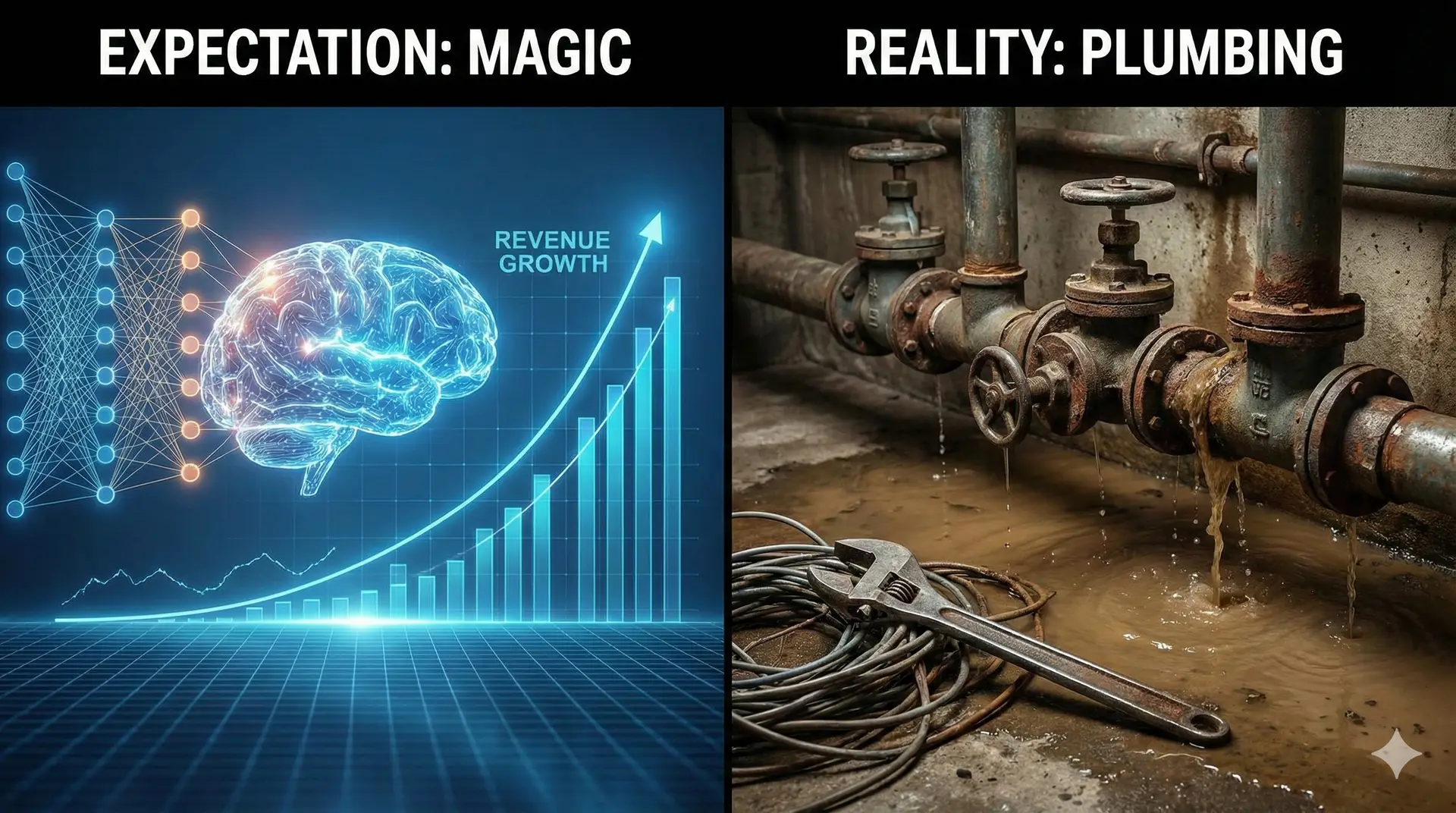
Their situation wasn’t unique. The company had invested millions in new analytics tools, hired a data science team, and launched several AI pilots. Yet the executive team didn’t trust the outputs. Reports contradicted one another. Pipelines broke weekly. Forecasts varied wildly depending on who built them. Everyone knew the data was important—but no one could rely on it.
After a few weeks of diagnostics, the root cause became clear:
The organization was trying to build analytics and AI on top of shaky foundations.
In other words, the problem wasn’t the teams. It wasn’t the technology. It wasn’t even the data itself.
It was the absence of a sturdy, well-designed data ecosystem—one that makes analytics and AI not only possible, but dependable.
This article walks through the same layered model we use with clients:
source systems → ingestion → storage → governance → analytics & AI.
You’ll learn what each layer does, the most common pitfalls, and how to tell whether your foundation is supporting your ambitions—or quietly sabotaging them.
🏗️ Why Your Data Foundations Matter More Than Your Tools
Most organizations make the same mistake: they jump straight to analytics dashboards, machine learning models, or AI assistants without first ensuring that their data ecosystem is healthy.
It’s like building a skyscraper on top of loose gravel. It might look impressive for a moment, but it’s only a matter of time before the cracks show.
Strong data foundations deliver three strategic advantages:
- 🔒 Trust — Executives believe the numbers and act decisively.
- ⚡ Speed — Teams spend more time analyzing and less time cleaning data.
- 📈 Scalability — Every new use case becomes easier, not harder.
Weak foundations deliver the opposite: rework, firefighting, budget waste, and stalled AI initiatives.
Let’s break down the five foundational layers and how you can assess your organization’s readiness.
1️⃣ Source Systems: Where the Truth Begins
Every insight, forecast, or AI output ultimately starts here—the CRM, ERP, POS system, HR suite, financial software, e-commerce platform, or custom applications your business uses daily.
⚠️ Common Pitfalls
- Fields added informally over time
- Inconsistent naming conventions
- Missing mandatory fields
- Manual entry that varies by team
- Legacy systems producing inconsistent formats
🧭 How to Know Yours Is Healthy
- Data is captured consistently
- Mandatory fields are enforced
- Every field has a clear purpose
- Origins of data are traceable
🛠️ Action Steps
- Audit the top 5–10 systems.
- Assign ownership for major data entities.
- Standardize data entry processes.
- Retire unused or duplicate fields.
2️⃣ Ingestion: Moving Data Reliably Into Your Ecosystem
Ingestion is the pipeline that moves data from systems into your warehouse or lakehouse.
⚠️ Common Pitfalls
- Brittle pipelines
- Jobs failing silently
- Schema changes breaking transformations
- Dashboards reflecting outdated data
🧭 How to Know Yours Is Healthy
- Automated, monitored ingestion
- Pipeline failures trigger alerts
- Schema drift detection in place
- Predictable ingestion cycles
🛠️ Action Steps
- Introduce ingestion monitoring.
- Automate pipelines with orchestration tools.
- Add schema change detection.
- Document all pipelines centrally.
3️⃣ Storage: Your Warehouse or Lakehouse 🗄️
Your storage environment is the beating heart of analytics.
⚠️ Common Pitfalls
- “Data swamp” environments
- No structured zones
- Poorly organized models
- Slow, unoptimized queries
🧭 How to Know Yours Is Healthy
- Clear zone architecture
- Business-aligned data models
- Consistent table loading
- Reliable performance
🛠️ Action Steps
- Establish raw, staged, and curated zones.
- Use recognized modeling frameworks.
- Adopt naming conventions.
- Archive or delete unused assets.
4️⃣ Governance: The Trust Layer 🛡️
Governance is how organizations ensure data is accurate, secure, and consistently defined.
⚠️ Common Pitfalls
- Glossaries no one uses
- Conflicting definitions
- Sporadic data quality checks
- Inconsistent access controls
🧭 How to Know Yours Is Healthy
- Clear data ownership
- Unified definitions
- Automated quality checks
- Standardized access controls
🛠️ Action Steps
- Build a business glossary.
- Assign owners and stewards.
- Implement automated data tests.
- Standardize access policies.
5️⃣ Analytics & AI: Where Value Comes Alive 🤖📊
This is the layer everyone sees—dashboards, predictions, decision tools, and automation.
⚠️ Common Pitfalls
- Analytics built before fixing upstream issues
- Models degrading silently
- Lack of monitoring
- Duplicate or inconsistent assets
🧭 How to Know Yours Is Healthy
- Consistent dashboards
- Reusable components
- Proper MLOps monitoring
- Responsible AI policies
🛠️ Action Steps
- Build curated semantic layers.
- Use MLOps practices for model health.
- Create reusable analytics components.
- Establish responsible AI guidelines.
🔗 Putting It All Together: A Healthy Data Ecosystem Is Layered, Intentional, and Scalable
When each layer works together, data becomes a strategic advantage—not an operational burden.
You’ll know your foundation is strong when:
- 🚫 Executives stop questioning the numbers
- 🔥 Data teams stop firefighting
- 🤝 AI pilots start scaling
- 🚀 New initiatives accelerate instead of stall
Most organizations don’t need more tools.
They need better structure and stronger foundations.
📚 A Before-and-After Story: What Transformation Really Looks Like
Before ❌
- 9 disconnected systems
- 4 different “truths” in sales reports
- Weekly pipeline failures
- Data team spending 70% of time cleaning
- AI pilots stuck in experimentation
After ✅
- Unified customer definitions
- Automated pipelines with monitoring
- Modeled warehouse with curated layers
- Preventative data quality checks
- Production-grade predictive models
- 40% faster analytics delivery
The CEO summarized it perfectly:
“We didn’t just fix our reporting—
we changed how we run the company.”
🧭 Practical Next Steps for Leaders
1. Diagnose Your Ecosystem 🔍
Map where inconsistencies occur and where time is being wasted.
2. Prioritize the Most Valuable Domains 💡
Focus first on customers, products, financials, and inventory.
3. Standardize Your Foundations 📏
Naming conventions, ownership, and pipeline monitoring create stability quickly.
4. Align Business + Data Teams 🤝
Shared definitions eliminate 50% of problems before they start.
5. Treat Analytics and AI as Products 🚀
Monitor them, maintain them, and continuously improve them.
✨ Your Data Ecosystem Can Become a Strategic Advantage
Poor data foundations cost organizations far more than they realize—missed opportunities, slow decisions, wasted budgets, and frustrated teams.
But with the right architecture and the right strategy, your data becomes:
- trustworthy
- scalable
- fast
- and AI-ready
Exactly as it should be.
📞 Ready to Strengthen Your Data Foundation? Let’s Talk.
If your data ecosystem feels chaotic—or if your analytics and AI ambitions feel stuck—we can help.
Our team specializes in building scalable, stable, and trusted data foundations that unlock analytics and AI safely and sustainably.
👉 Let’s turn your data ecosystem into your competitive advantage. Contact us to get started.