

Marcus walked into the Q4 board meeting with a sense of accomplishment.
As the Chief Data Officer (CDO) of a mid-sized logistics firm, he had spent his first 18 months doing exactly what the textbooks said to do. He had selected a best-in-class cloud warehouse, implemented a rigorous data catalog, established a governance council, and cleaned up the “customer_ID” duplication issue that had plagued the company for a decade.
He presented his slide deck: “Foundational Integrity: 98% Complete.”
The CEO looked at the slide, then at Marcus. “This is great, Marcus. But our competitor just launched an AI-driven dynamic pricing model that is eating our margins. Where is our AI strategy? And why can’t Marketing target users based on last month’s shipping data yet?”
Six months later, Marcus was gone.
Marcus didn’t fail because he was incompetent. He failed because he fell into the “Defensive Trap.” And he is not alone. Industry statistics consistently show that the average tenure of a CDO hovers precariously around 24 months—often the shortest tenure in the C-suite.
Why is this role so volatile? And more importantly, if you are a data leader (or the executive hiring one), how do you stop the clock? ⏳
The “Magic vs. Plumbing” Disconnect
The fundamental friction in the CDO role stems from a misalignment of expectations.
The Board and the CEO read about Generative AI adding trillions to the global economy. They see headlines about NVIDIA’s stock price and ChatGPT’s user base. They hire a CDO expecting Magic: AI products, revenue optimization, and predictive crystal balls.
The CDO arrives and looks under the hood. They see Plumbing problems: fragmented silos, zero documentation, security risks, and excel spreadsheets held together by hope.

When the CDO prioritizes the plumbing—which they technically must do to make the magic work—the business perceives a lack of progress.
We are seeing this play out in the news right now. As reported by The Wall Street Journal, many companies are currently pulling back on AI spending or restructuring their data teams because the initial “hype” didn’t translate into immediate productivity gains [1]. Executives are losing patience with “science projects” that don’t move the P&L.
If you spend your first two years strictly on governance, migration, and cleaning, you are essentially asking the business to pay for a renovation of a house they aren’t allowed to live in yet.
Playing Offense in a Defensive World
To survive past the two-year mark, you must fundamentally change your strategy. You need to balance Defense (Risk, Compliance, Governance) with Offense (Revenue, Customer Experience, Speed).
Here is the hard truth: Defense keeps you safe, but Offense keeps you hired. 🛡️⚔️
Consider the recent case of Klarna. While many companies were bogged down in data privacy discussions (Defense), Klarna aggressively deployed an AI assistant that handled 2.3 million conversations in its first month—doing the work of 700 full-time agents [2]. That is Offense. That is a metric the CFO understands immediately.
Does Klarna still need data governance? Absolutely. But by leading with a massive value win, their data leadership bought themselves the political capital and budget to fix the plumbing in the background.

The Strategy: The 70/30 Rule For every dollar or hour you spend on foundational work (Defense), you should spend 30% of it ensuring that work is tied to a visible, revenue-generating use case (Offense).
- Don’t just “clean the customer data.”
- Do launch a “High-Value Churn Predictor” pilot while cleaning the data required to build it.
The Reporting Line Paradox
Where the CDO sits in the organization is often a predictor of their destiny.
If you report to the CIO, you are viewed as IT Support. Your KPIs will likely be uptime, ticket resolution, and cost containment. In this structure, data is treated as a liability to be managed or a service to be requested.
If you report to the CEO (or COO/Chief Strategy Officer), you are viewed as a Business Driver. Your KPIs are revenue, efficiency, and transformation.
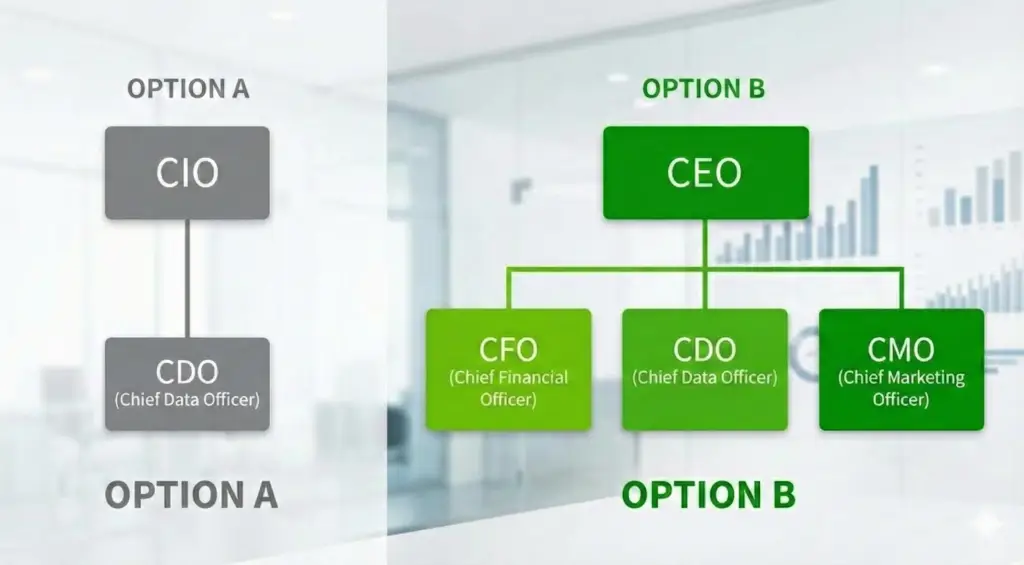
Recent trends suggest a shift. As noted in the Harvard Business Review, successful data organizations are increasingly treating data as a product, moving away from the IT service-desk model [3]. If you are currently buried in the IT organization, your first strategic move must be to forge direct alliances with the P&L owners (Sales, Marketing, Operations). You may not be able to change your reporting line immediately, but you can change who you serve.
Culture Eats Data for Breakfast
You can buy Snowflake. You can buy Databricks. You can buy Microsoft Copilot.
You cannot buy a data-driven culture.
The most common reason for the “24-month exit” isn’t technical failure; it’s adoption failure. The CDO builds a beautiful dashboard, but the VP of Sales ignores it and makes decisions based on “gut feel” and a legacy spreadsheet.
When this happens, the CDO often blames “data literacy.” But often, the blame lies with the data team for building things nobody asked for.
The Solution: Product Management Mindset Treat your internal colleagues as customers. Do not ask them, “What data do you need?” Ask them, “What decision are you afraid to make today?” or “What problem is costing you your bonus?”
Solve that specific problem.
If you solve a VP’s headache, you gain a champion. If you build them a compliance dashboard, you gain a taskmaster.
From Gatekeeper to Shopkeeper
Finally, we must address the “Police” problem. 👮
Many CDOs view their primary role as stopping bad things from happening. They lock down access. They create bureaucratic approval workflows for SQL access. They become the “Department of No.”
In the era of AI, this is fatal. Generative AI thrives on access to unstructured data. If you lock everything down, shadow IT will explode. Teams will simply upload sensitive CSVs to personal ChatGPT accounts to get their work done, creating the very security nightmare you were trying to prevent.

Shift your identity from Gatekeeper to Shopkeeper.
- The Gatekeeper says: “You can’t see this data until you fill out form 34B.”
- The Shopkeeper says: “Here are the certified, clean datasets on the shelf. If you use these, I guarantee their quality. If you go to the back alley (raw data), you’re on your own.”
Conclusion: Surviving Year One
To the CDOs reading this: Your clock is ticking. To the CEOs hiring them: Ensure you aren’t setting them up for the “Defensive Trap.”
Here is your survival guide for the next quarter:
- Audit your roadmap: If it’s 100% infrastructure, pause.
- Find your “Klarna” moment: Identify one high-friction business process that AI or analytics can solve now, imperfectly but valuably.
- Stop talking about architecture: In your next board meeting, do not mention “pipelines,” “latency,” or “schemas.” Talk about “customer retention,” “inventory reduction,” and “margin protection.”
Data is no longer a support function. It is the engine of the modern enterprise. But an engine that sits in the garage being polished doesn’t win races.
Get the car on the track. 🏎️
Is your data strategy stuck in the ‘Defensive Trap’? We help organizations pivot from governance-heavy cost centers to value-generating innovation hubs. Book a 30-minute Strategy Diagnostic to see how we can help you show ROI in Q1.
References: [1] The Wall Street Journal, “Companies Are Rethinking Their AI Spending,” 2024. [2] Klarna Press Release, “Klarna AI assistant handles two-thirds of customer service chats in its first month,” 2024. [3] Harvard Business Review, “Data Science and the Art of Persuasion,” updated 2024 context.2024.